From Piers Morgan spitting a vegan sausage roll on live television to Julia Hartley-Brewer having viral confrontations with vegan activists. How exactly is the attention economy turning outrage-driven content around veganism into revenue?

It is January 2019. Piers Morgan, co-host of ITV’s Good Morning Britain and one of Britain’s most-watched television hosts, picks up a Greggs vegan sausage roll, bites into it, and spits it into a bucket placed under his desk for the purpose. He holds up the packet, grimaces at the camera, and declares it disgusting. Days earlier, he had already tweeted at the bakery chain, “Nobody was waiting for a vegan bloody sausage, you PC-ravaged clowns.”
Greggs’ social media team replied within minutes, “Oh, hello Piers, we’ve been expecting you.” That single reply earned 20,000 retweets and 144,000 likes. What had started as a bakery product launch had now become a full-scale culture war flashpoint.
Chas Newkey-Burden is a British journalist and author. He writes about veganism and animal liberation for The Guardian, The Telegraph, The Metro, Plant Based News, and others. “Greggs would not be seen as a woke clientele. It would be the sort of place where people who read The Sun, more than people who read The Guardian. And so therefore, when they very early on in the vegan food revolution launched a vegan sausage roll, it was a massive moment, and Piers Morgan would not shut up for weeks about this bloody sausage roll,” he said.
The financial result was staggering. Greggs reported a 58 per cent rise in underlying first-half profit for 2019, with total sales hitting £546 million, up by 14.7 per cent. Annual sales topped £1 billion for the first time, and the company’s share price rose by nearly 90 per cent over the year. Morgan’s outrage had done what no marketing budget could, and it made a sausage roll controversial enough to become national news.
Morgan’s Greggs performance was not a one-off. Across Good Morning Britain and his later TalkTV show Piers Morgan Uncensored, Morgan built a recurring brand around vegan outrage. In 2018, he called vegans ‘terrorists’ during a live debate with activist Joey Carbstrong. He told another vegan guest, “I’ve never met a healthy-looking… vegan, you’re a bit pale, and you’re really angry.” When Piers Morgan Uncensored launched in April 2022, he opened by ranting against ‘vegan virtue signalers’ who want to make mincemeat out of people for eating steak. Each time, the pattern was the same: provoke, generate a reaction, and go viral.
Digital advertising pays publishers and platforms based on time-on-page and advertising impressions. According to Ofcom’s 2024 News Consumption report, 71 per cent of UK adults now access news online, with more than half (52 per cent) using social media specifically for news. That shift has tied newsroom and platform revenue directly to engagement. Every share, reply, and furious comment on a clip of Morgan baiting a vegan activist is engagement that the algorithm rewards with greater reach and greater advertising revenue.
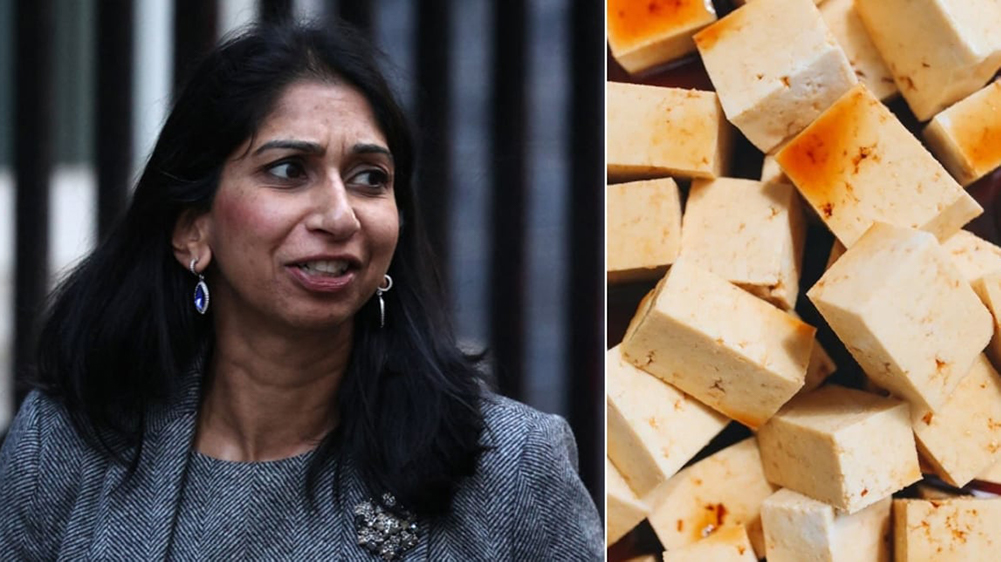
On 18 October 2022, Home Secretary Suella Braverman stood at the despatch box in the House of Commons, during a debate on the Public Order Bill targeting Just Stop Oil and Extinction Rebellion, and told MPs: “It’s the Labour Party, it’s the Lib Dems, it’s the coalition of chaos, it’s the Guardian-reading, tofu-eating wokerati, dare I say, the anti-growth coalition, that we have to thank for the disruption that we are seeing on our roads today.”
Within hours, ‘tofu-eating wokerati’ was trending across social media. The clip was watched by millions of times. Braverman was fired the following day. The clip kept circulating.
This is what Newkey-Burden means when he describes plant-based food becoming ‘another stick’ in the culture war arsenal. “There’s even a Tory MP who used to talk about woke something like woke kale munching vegan trans lives matter snowflakes,” he said. “And it was a phrase they used every time, and they saw these things together. And yeah, it just became another stick.” Braverman’s formulation did exactly this by collapsing tofu into a single phrase alongside environmental protest and political opposition. It assigned a dietary choice a political identity and an enemy. It is designed to provoke. And in the attention economy, provocation is currency.
Alex Lockwood, a senior lecturer in media, ecology, and politics at the University of Sunderland who has spent years researching how veganism is framed in British media, explains why food produces this reaction more reliably than almost any other subject. “Food is one of the strongest and most ingrained and important relationships we have,” he said. “Food is the very bonding of social groups. So when you challenge those relations, it tells us what our food identity is actually about, and then they provoke very strong reactions.”
“Those strong reactions are the things the media really feeds upon and uses to maintain audience engagement. The stronger the emotional reaction, the more attention is given to that particular piece of content,” Lockwood said. “They have a business model built upon provoking people’s emotions. Emotions of outrage and anger are much more useful in terms of maintaining attention than emotions of peace and harmony.” A 2022 academic study in Humanities and Social Sciences Communications found that antagonistic communities, including what researchers labelled the ‘Piers Morgan community’, dominated the online discourse around the Greggs vegan sausage roll, drawing in audiences far beyond the original debate.
In this system, anger is not a side effect. It keeps readers scrolling. Scrolling generates advertising impressions. Impressions generate revenue. Journalist Newkey-Burden said, “A thoughtful piece about plant-based nutrition might attract five thousand readers while an article headlined ‘Because I’m Vegan, I’m Better Than You, and You Know It’, which The Telegraph actually ran, will attract fifty thousand.”
“I think if something’s just going in an old-fashioned newspaper, then you still have to have a headline that makes the person want to read that story as they turn that page, but it has to be less enticing,” he said. “Whereas when it’s online, everybody is obviously competing for clicks.”
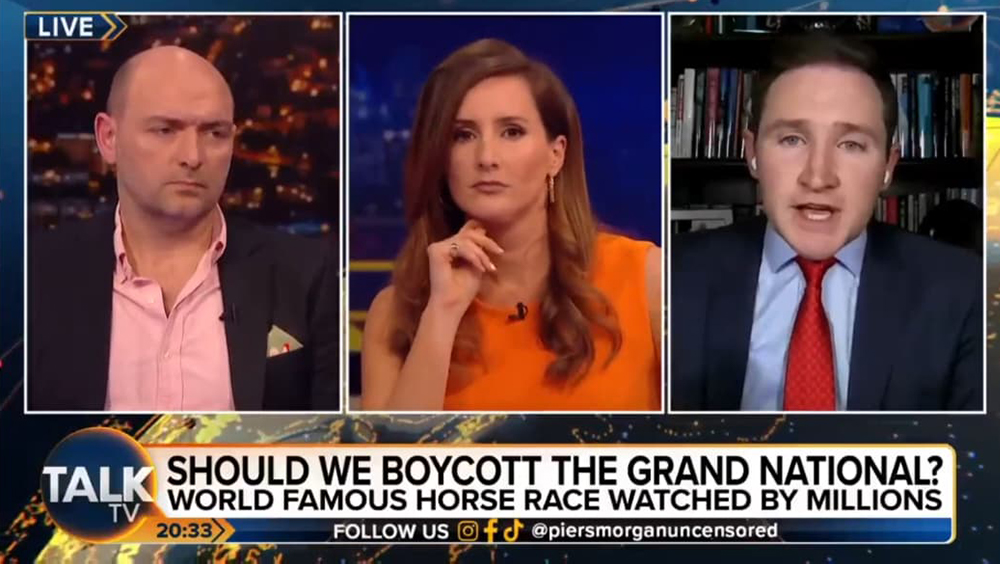
The formula Morgan pioneered was adopted across the culture war media ecosystem. Julia Hartley-Brewer, who hosts a breakfast show on TalkTV, and Dan Wootton, who presented a prime-time programme on GB News, the right-leaning TV channel that launched in 2021 and positions itself as a corrective to ‘woke’ mainstream media, both learned that booking a vegan activist and allowing the confrontation to generate clips was reliably good for ratings.
Lockwood experienced this directly. He appeared on Morgan’s show representing Animal Rising and did interviews with both Wootton and Hartley-Brewer.
“Even as I got off, their producers would say, oh, they really enjoyed that. That was great. Really good argument kind of thing,” he said. “And it made it very clear to me that it was very much a performance.” “I’m sure they do believe it but the reason they like it so much is because it feeds their audience.”
When Animal Rising staged its highest-profile action in April 2023, the media response demonstrated how the same dynamic scales. More than 300 activists descended on Aintree Racecourse before the Grand National, climbing perimeter fences and running onto the track. 118 people were arrested. The race was watched by 7.5 million people on ITV alone. Three horses died over the course of the three-day festival.
“One of the things that they always try to do is frame you as the minority,” Lockwood said. “It’s just a small bunch of troublesome activists who are disrupting the fun and common sense lives of the majority of ordinary people.” The narrative is pre-written. The villain is cast before the cameras arrive.
The reason vegan content generates this reaction so reliably comes down to identity, and social media algorithms have learned to exploit this with precision. “Any outgroup, like a vegan or animal rights activist, is always positioned as the outgroup and therefore receives a lot of easily directed antagonism and anger,” Lockwood said. “Social media algorithms are really very clear reflections of how the human nature of needing to belong socially works. So they will promote anti-vegan content because it gets shared a lot.” Research by media academics Karen Morgan and Matthew Cole found that 74.3 per cent of newspaper coverage of vegans and veganism in UK national newspapers was negative. Those patterns of negativity are what the algorithm has learned to serve.
Newkey-Burden witnessed that machine at work in January 2017, when his Guardian opinion piece ‘Dairy is Scary’ went viral the day after the Mail Online published a major exposé of welfare violations at a dairy farm supplying Marks and Spencer. The article reached hundreds of thousands of readers within hours. “The dairy lobby was bombarding the Guardian with pressure,” he said.
“They were pressuring them incredibly brutally to take the article down.” Dairy organisations hired vets to write to the paper and coordinated responses. Groups that had never publicly united before issued a joint statement condemning him. “I was getting bombarded with very, very unpleasant tweets and DMs from dairy farmers as well.” The article stayed up. The traffic kept rising. And the money was flowing to every platform hosting the argument.
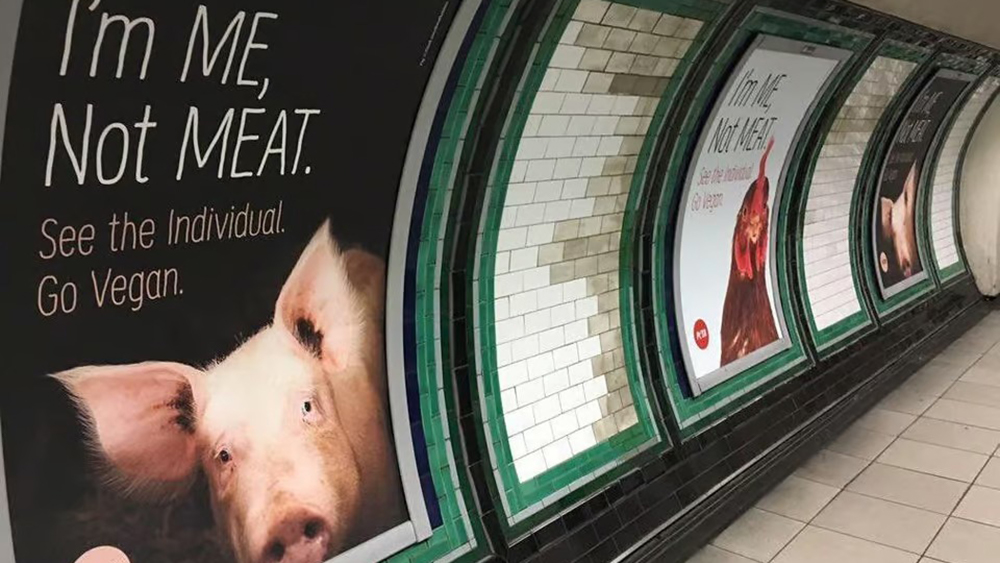
Some activists have concluded the only rational response is to feed the machine deliberately. “A lot of organisations and activists have decided that their strategy is to feed that,” Lockwood said. “To provide provocative stories that provoke the same kinds of emotion, because that will guarantee media coverage. PETA is a very good example of that.” Provocative stunts guarantee coverage but also ensure veganism remains permanently associated with extremism, because extreme content is the only content the algorithm reliably rewards.
Newkey-Burden has played the same game himself. He timed a column arguing that every element of a traditional Christmas dinner involved animal suffering to run on Christmas Day in The Spectator. “I did one for Christmas day,” he said.
“The Spectator put it online on Christmas Day. So this was ostensibly a pro-vegan article, but it got absolutely blown up, inevitably, because people on Christmas Day were reading The Spectator before they had their lunch, and then there was me going through it bit by bit.” He understood exactly what he was doing. The provocative timing generates the clicks. The clicks generate the advertising revenue. The revenue incentivises more provocative content.
Back on 7 September 2022, after Morgan finished his Big Mac and Coghlan finally got a word in, Ofcom received more than 100 complaints about the segment. Every complainant had watched the clip. Every view was an impression. Every angry share was engagement. The platforms profited from all of it. “They have a business model built upon provoking people’s emotions,”
Lockwood said. This is how your anger about veganism makes someone rich. The outrage is real. The performance is calculated. And the profit goes to everyone except the people being mocked.