
Fraud investigations into Chinese influencers surged by a staggering 217% in 2024, exposing the widespread fabrication of reality for profit. Amidst this severe trust crisis, how can China’s digital economy escape its algorithmic ‘iron cage’ and rebuild a healthy ethical ecosystem?
When influencer Zhang Junjie was forced to admit that the seemingly naive villagers in his videos were merely actors in fabricated scenes shot in rented private rooms, the veneer of the entire digital content industry was ruthlessly torn away. This is by no means an isolated moral blemish, but rather a systemic scar left by China’s digital economy during its relentless sprint forward.
This industrial chain, which propagates tragic encounters, not only erodes public trust but also distorts societal values and rationality through the reverse incentives of algorithms. From fraudulent poverty alleviation campaigns to scripted family ethical disputes, these meticulously engineered ‘realities’ are being mass-produced to monetise human suffering.
Participants in the influencer economy are deeply ensnared in a battle between technology and human nature. Technological empowerment presents two diametrically opposed facets: whilst it reduces creative constraints, it simultaneously forces influencers under the control of algorithmic surveillance systems. In an era that pushes the attention economy to its absolute extreme, what kind of grotesque symbiotic relationship has formed amongst creators, MCN agencies, and platform algorithms? And how can we break this deadlock?

At the core of the issue lies the ‘paradox of authenticity’, which content production has gradually entered under the drive of platform capitalism. The traffic distribution mechanisms of algorithms are far from neutral; they frequently act as catalysts that magnify human frailties.
Research indicates that content containing poverty-related tags can activate algorithmic boost factors, escalating its traffic weighting by an astonishing 2.8 times, which directly results in the mass manufacturing of ‘misery industry chains’. Concurrently, when viewers engage with conflict-oriented tags, traffic on video platforms such as YouTube can surge by 3.2 times, making the ‘ugly economy’ increasingly prominent.
Although social platforms ostensibly champion platform progress, they effectively convert the decline of human morality into hard cash through their business models. Under such perverse incentives, the authenticity of content creators entirely succumbs to algorithmic preferences.
Driven by capital, MCN agencies further fuel the fire. When Zhang Junjie first commenced his career, his MCN agency demanded he fabricate fictional life stories as part of his online persona to precisely harvest middle-class female followers. This system, which transforms human suffering into automated clickstreams, pushes content creation to the edge of a moral precipice.
Examined through the lens of neuroethics, this chaos stems from profound physiological and psychological roots. When faced with the choice between ‘high-yield violations’ and ‘low-risk compliance’ in live-streaming scenarios, up to 68% of influencers regress to the ‘pre-conventional level’ of moral cognitive development, pivoting towards egoistic thought patterns.
Neuroeconomic investigations further corroborate that, stimulated by the dopamine effect, the physiological correlation to reward quantities leads 68% of practitioners to breach ethical standards during live broadcasts.
When streamers exhibit intense emotions during live streams, neural activity in their prefrontal cortex significantly decreases, whilst the activation rate of the limbic system rises to 27%, highly aligning with addictive behavioural patterns.
Structural contradictions at the macro level are equally impossible to ignore. The unique ‘traffic purchasing plus slot fee’ traffic-casting system of domestic platforms forces influencers to pour money into advertising products like DOU+, turning content creation into a gamble highly dependent on algorithms.
Both domestic and foreign platforms, as well as MCN agencies, dedicate up to 45% of their revenue to traffic acquisition, thereby exploiting human vulnerabilities and utilising algorithmic pleasure-optimisation methods to generate income.
This localised model of digital capitalism inherently shifts moral risks entirely onto the market.
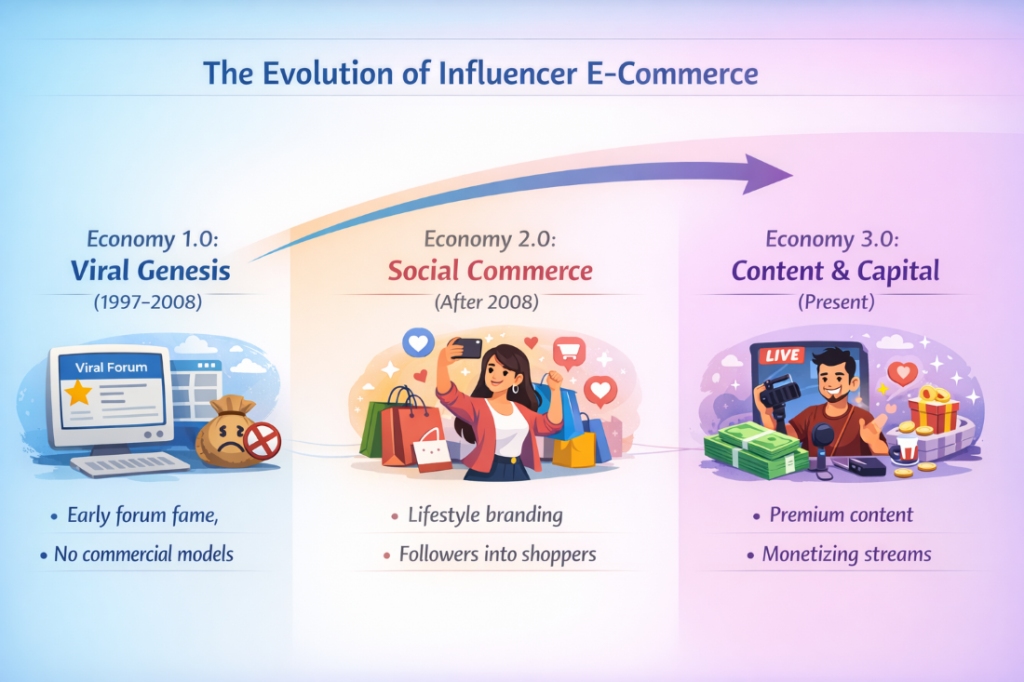
Once a blogger’s fabricated poverty narrative is exposed, their affiliated MCN agency can still rapidly incubate alternative accounts via traffic replacement, continuing to reap profits within this ecosystem.
In this ‘post-truth’ era, the industrialised production of authenticity constitutes, in essence, a form of symbolic violence.
As Jean Baudrillard warned in Simulacra and Simulation, when hyperreality replaces reality as the benchmark of value, society will inevitably plunge into the abyss of ethical relativism.
Technical engineers continuously convert authentic content into algorithm-driven appeals, rendering the ethical standards established by tech companies effectively meaningless.
Such pseudo-technological innovation schemes transform Marshall McLuhan’s theories into principles of corporate surveillance, allowing systemic fraudulent behaviours to run rampant.
In vertical sectors such as fast-moving consumer goods (FMCG), practitioners under immense pressure for immediate conversion can afford only minimal attention to consumer-end information transparency, leading to significant instantaneous moral decision-making dilemmas.
The adoption of technology has even eradicated the most fundamental business principle of ‘showing consumers what they will receive’. Research indicates that using a 16mm lens to distort and magnify the size of a burger by 217% has been flagged by algorithms as innovative content and heavily promoted as a standard marketing technique.
The structural contradiction between economic functions and societal side effects has precipitated the emergence of performative authenticity and misery industry chains; this not only undermines value rationality in the public sphere but also destroys intergenerational equity.
The systemic collapse of value rationality within the cyberspace of the digital age precisely corroborates Neil Postman’s law of survival—’amusing ourselves to death’—as predicated by algorithms.
To break this deadlock, contextualised governance solutions must be adopted.
At the platform mechanism level, it is imperative to establish a dynamic traffic quality assessment system, incorporating user retention rates and reporting response speeds into the algorithmic parameters.
More crucially, the income distribution mechanism must be restructured, for instance, by piloting a ‘moral point system’ that applies weighted rewards to the organic traffic of accounts consistently producing positive and constructive content.
Regarding neuroethical intervention mechanisms, the study recommends introducing mandatory delay settings for live broadcasts to provide practitioners with a buffer period for moral reflection.
Furthermore, dopamine release threshold alerts should be integrated to trigger cooling-off periods, and a vocational training system should be established, implementing Kohlberg’s theoretical principles as ”moral cognition enhancement” courses.
Chinese influencer industry is currently experiencing an evolution between two starkly distinct phases: transitioning from barbaric growth to professional deep cultivation. The figures struggling bitterly between ethics and traffic are illuminating the path of transformation for this colossal economy.
The integration of technological development and institutional capacity-building has generated a practical framework capable of effectively resolving the collapse of trust within algorithmic systems. Evolving industry standards indicate that content creators who maintain their original creative intent whilst selecting revenue streams will establish themselves as the new benchmarks for the sector.
As the tide recedes, the hype of blindly pursuing eyeballs will ultimately be discarded. Just as top beauty streamer Black Liu predicted: ”The market will eventually return to an operational model that demonstrates its fundamental value”.
In this protracted and arduous journey of self-redemption, Zhang Junjie’s epiphany is perhaps the best counsel for the entire industry: ”Traffic is an amplifier; the core must be sincerity”.